The Dialectical Imagination: A History of the Frankfurt School and the Institute of Social Research, 1923-1950 by Martin Jay
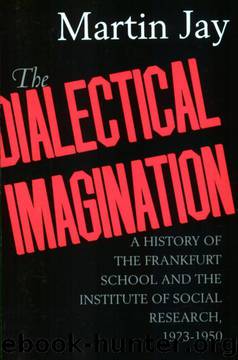
Author:Martin Jay [Jay, Martin]
Language: eng
Format: epub
Published: 2010-11-24T12:45:00+00:00
The central theme of the work is a relatively new concept -- the rise of an "anthropological" species we call the authoritarian type of man.
- MAX HORKHEIME.R
The war years brought a serious reevaluation of the Institut's goals and a gradual redefinition of its institutional structure. Horkheimer's circulatory illness, which necessitated the move to California, and the increased involvement of other Institut members in government service meant that the type of connection with Columbia enjoyed by the Institut since 1934 was no longer possible. Moreover, a new internal factor within the university's sociology department spelled potential trouble for the future. The struggle for control between the department's more speculative wing, led by Robert Maclver, and its empirically oriented counterpart around Robert Lynd had been resolved largely in favor of the latter. Or at least so Lowenthal reported to Horkheimer by letter on January 23, 1942. Thus, not surprisingly, Horkheimer was willing to permit the loosening of the Institut's ties with Columbia brought by the war and his illness. In fact, as early as May, 1941, before the resolution of the Lynd-Maclver conflict, he had expressed to Lowenthal ambivalence about the consequences of the sustained relationship with Columbia.' The leadership of the Institut, despite its awareness of the need to maintain an institutional identity, was always concerned about the possible sclerosis that overinstitutionalization might bring.
Still, with the end of the war, an attempt was made to keep the Institut on Morningside Heights. Horkheimer's illness had become less of an immediate worry, allowing him to come back to New York in 1944 and 1945 for extended periods of time. Although certain Institut members, such as Marcuse, chose to remain with the govern ment, others were eager to return to a full academic life. Within Columbia hopes were still alive to retain the Institut in some capacity. Ironically, the major effort to revive the Institut's connection came from within the ranks of the empirical sociologists. Paul Lazarsfeld, who had transformed his Office of Radio Research into a newly constituted Bureau of Applied Social Research,' suggested the integration of the Institut into his bureau. Despite the failure of his collaboration with Adorno before the war, Lazarsfeld was optimistic about the interaction of Critical Theory with his own brand of "administrative research." J In a series of letters to other members of the department, such as Theodore Abel and Robert Merton. Lazarsfeld extolled the Institut's accomplishments. On February 5, 1946, he wrote to Abel that the department had done an injustice to the Institut, but not because of the former's own shortsightedness:
the whole mess is due to the idiocy of the Institute group. I told them for years that publishing in German will finally destroy them. But they had the fixed idea that their contribution to America will be greater if they preserve in this country the last island of German culture. This is especially true of their Zeitschrift. I have asked Lowenthal, its former editor, to make a brief content analysis of the ten volumes which have appeared in this country.
Download
This site does not store any files on its server. We only index and link to content provided by other sites. Please contact the content providers to delete copyright contents if any and email us, we'll remove relevant links or contents immediately.
| Africa | Americas |
| Arctic & Antarctica | Asia |
| Australia & Oceania | Europe |
| Middle East | Russia |
| United States | World |
| Ancient Civilizations | Military |
| Historical Study & Educational Resources |
Room 212 by Kate Stewart(5119)
The Crown by Robert Lacey(4814)
Endurance: Shackleton's Incredible Voyage by Alfred Lansing(4780)
The Iron Duke by The Iron Duke(4354)
The Rape of Nanking by Iris Chang(4211)
Joan of Arc by Mary Gordon(4109)
Killing England by Bill O'Reilly(4001)
Say Nothing by Patrick Radden Keefe(3983)
I'll Give You the Sun by Jandy Nelson(3445)
Shadow of Night by Deborah Harkness(3366)
Hitler's Monsters by Eric Kurlander(3341)
Mary, Queen of Scots, and the Murder of Lord Darnley by Alison Weir(3210)
Blood and Sand by Alex Von Tunzelmann(3203)
Eleanor & Park by Rainbow Rowell(3169)
Darkest Hour by Anthony McCarten(3129)
Margaret Thatcher: The Autobiography by Thatcher Margaret(3081)
Book of Life by Deborah Harkness(2937)
Red Famine: Stalin's War on Ukraine by Anne Applebaum(2932)
The One Memory of Flora Banks by Emily Barr(2863)
